"...is labelling books that have received nary a challenge as ‘banned’ an innocent way to engage readers in works critical to the status quo, or could they perhaps be fomenting a dangerous undercurrent of hatred and feelings of disenfranchisement? To answer that question, we must first ask ourselves: what the hell is a 'banned book,' anyways?"
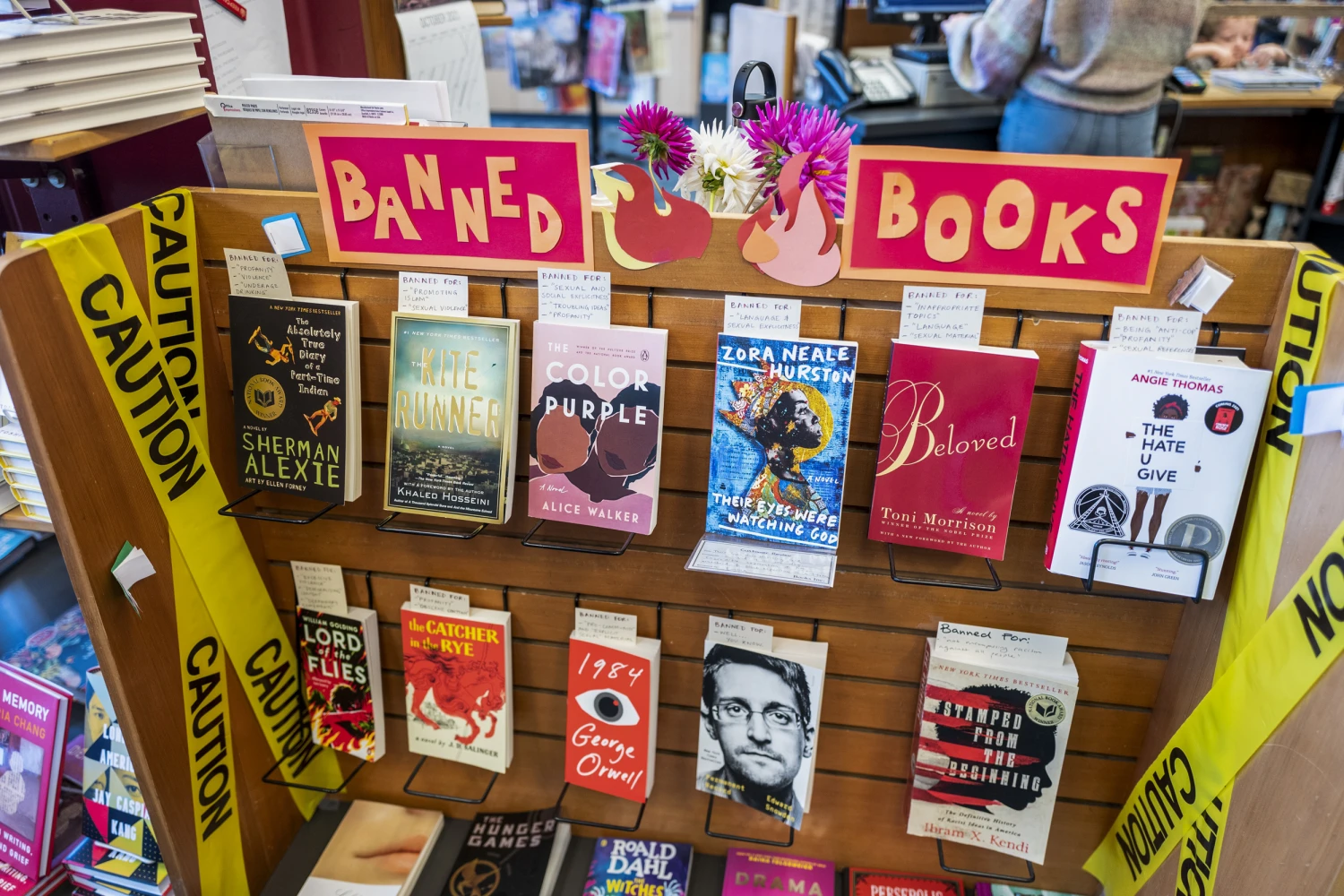
Walk into any bookstore in any town in America and you will be immediately met by a table of supposedly 'banned' books. To the average consumer, it's easy to take this proclamation at face value. After all, it's no secret that oppressive regimes of yore have engaged in book-banning to suppress the flow of information and intimidate authors. However, even a moment of reflection would immediately return the fact that, in America, no books (barring those made with the express purpose of spreading information on how to build explosives, for instance) are banned! So what are these tables getting at in the first place? Is this new ‘banned book’ phenomenon an attempt to sell books that were actually banned at some point, or does it mark the creation of a new genre, or is it merely a marketing technique? And is labelling books that have received nary a challenge as ‘banned’ an innocent way to engage readers in works critical to the status quo, or could they perhaps be fomenting a dangerous undercurrent of hatred and feelings of disenfranchisement? To answer that question, we must first ask ourselves: what the hell is a 'banned book,' anyways?
For the purpose of this investigation, we will be defining what society means by 'banned books' according to a list of books commonly included in the 'banned books' section at Barnes and Noble. This seems to be the fairest approach, as Barnes and Noble is the nation's largest book-store chain and we might therefore assume some level of standardization in the assessment of books as 'banned.' Furthermore, to include every independent book store's banned book displays would be absolutely impractical for this writer—and would no doubt complicate the search for a definition by introducing outliers so far away from being banned that it would confound our attempts at finding a definition (for instance, I have just now witnessed a copy of John Greene's 'Looking for Alaska' in a banned book section at DCA. How utterly ridiculous!).
We will conduct this investigation in the Aristotelian manner. That is, we'll assess several viable definitions of a 'banned book' against the reality of what books are considered 'banned' to search for one that works. Our primary goal is to find a definition that describes what is commonly meant when we call a book ‘banned’ without being too broad (as to include every book) or too narrow (as to exclude books that are commonly found in ‘banned books’ sections). If none can be found, we will then offer our own definition. Upon arriving at a definition, I will offer a brief analysis of the social consequences therein.
To the point of considering multiple candidate definitions, we already know that 'banned' can't possibly mean 'banned right now, right here.' Otherwise, police would raid every bookstore in America! So, we'll begin by examining the following definitions:
1. A book is 'banned' when it has been banned at some point by some government.
2. A book is 'banned' when it has been banned at some point by some organization.
3. A book is 'banned' when it has faced some amount of widespread adverse scrutiny by society against its writing or publication.
The first definition is perhaps the most natural evolution from the realization that a ‘banned book’ cannot actually be banned inasmuch as it is available for legal purchase. Picture yourself at the Barnes and Noble ‘banned book’ table. Before you is a copy of Fahrenheit 451, which was in fact banned and actively destroyed by the South African gov’t from the 1950s to the 70s. Certainly, this is a novel that can be rightly considered ‘banned’ under this definition. But, then, you pick up Lord of the Flies (a veritable hallmark of the ‘banned book’ section), sitting just inches away on the display table. This book has never received a blanket ban by any government, ever. So, therefore, this first definition is too narrow; it fails to account for the ‘banned’ books that have never actually been banned by a government.
Aha! Comes the rejoinder, what about an absurdly oppressive society such as North Korea that has indeed banned this book by virtue of banning all (or an overwhelming majority of) western media? In the face of such a challenge it is enough to say that to consider the most extreme examples as a fair test for what constitutes a ‘banned book’ would render such salacious and controversial titles as Clifford the Big Red Dog and Anne of Green Gables ‘banned.’ Such a consideration would obviously make our definition too broad, so we must dismiss this counter.
We move on to the second definition, then, and we begin to find a definition with some merit. Indeed, many books have been banned by certain non-or-merely-psuedo-government entities such as churches or school districts. Indeed, as you ponder (summoning again the image of the ‘banned book’ table before you) the book in your hands, you note that The Lord of the Flies has, indeed, been challenged and banned at certain schools. Perhaps this second definition is adequate? Two challenges emerge:
First, this definition sets the bar spectacularly low. Many organizations ban large swathes of books for reasons less related to the intellectual content of the books (what we typically take issue with as it pertains to book bans) and more so because of the vulgar or obscene content contained within them. Would we expect to find “Playboy” in a banned book section by virtue of its not being available in Sunday Schools?
Second, this definition tends to include books that the general population would scarcely consider ‘banned.’ Consider the fact that fringe groups, such as scientology, might ban members from reading certain books (whether through explicit or implicit means makes little difference). Should these books be included in our search for society’s definition of a ‘banned book?’ Obviously, a group such as this is so small that it would hardly make logical sense to consider their doctrine when evaluating what we mean when we say a book is ‘banned.’ Likewise, as membership to such a group (and, in truth, almost all private organizations) is purely elective, the books are banned only insofar as you remain a member of that group. Which is to say, the books are not banned!
All of these issues with the second definition swell and burst as you pick up yet another common haunt of the ‘banned book’ section: To Kill a Mockingbird. Though certainly the victim of many challenges, this novel has never been banned by any organization, ever, as far as this author can tell. So what the hell is a banned book!?
(Side note: some might fire back that To Kill a Mockingbird was successfully challenged and removed from required reading lists at several institutions. Response: If omission from an organization’s required reading list constitutes a ‘ban,’ than 99.999…% of the literary corpus is therefore ‘banned’)
This brings us to our final and most pathetic definition yet: a banned book is one that has faced some amount of widespread scrutiny. And yes, finally, this definition seems to fit all of the books examined above. Because, the fact is, all great art must face some level of scrutiny—the purpose of art is to rouse emotions within the viewer, and there will inevitably be pushback for the works that accomplish such a feat with the greatest effect. But then, and I’m not joking when I say I’ve seen this book included in just about every ‘banned book’ table I’ve ever seen in a Barnes and Noble, you cast your glance upon Angie Thomas’ 2017 novel, The Hate U Give.
That just tears it.
This book, a NYT Bestseller, is so UNBANNED that it has received nigh UNCOUNTABLE accolades including TEN notable literary awards. It is so SHEERLY and FLAGRANTLY unbanned that it received a MOVIE DEAL AS SOON AS IT WAS AUCTIONED. A deal that, by the way, resulted in a released movie just TWO years later that grossed THIRTY-TWO MILLION DOLLARS.
What the hell are we even talking about at this point? Sure, this book may have received some scrutiny from a minority of people, but that didn’t stop it from being a roaring literary success! Can our bar for ‘banned books’ be set as low as having a handful of people dislike your book? Why, then, we run back into the same problem we’ve been hitting: when the definition of a ‘banned book’ is relaxed enough to encompass everything that the book industry wants you to believe is a banned book, then everything becomes a banned book!
This is, of course, assuming that our criterion (largely rooted in whether or not a book has been banned or challenged) have been properly set. But, if this analysis has proven anything, it has at least shown that becoming a ‘banned’ book has absolutely nothing—nada, zilch—with being banned, or challenged, or scrutinized in a meaningful way. Instead, the only thing that could possibly connect the disparate books found within your standard-fare ‘banned books’ section is this: they are all progressive novels that are critical of some aspect of society. Fahrenheit 451 criticized our slow march towards techno-fascism, The Lord of The Flies reflected the lawlessness of man in the arbitrary (and ultimately fatal) quarrels of children, To Kill a Mockingbird launched a searing attack against the deeply ingrained and utterly banal racism of the Jim Crow era, and The Hate U Give presumably said more of the same.
Having arrived at a coherent definition that passes the smell check, seemingly broad enough to include those books typically considered ‘banned’ and narrow enough to exclude fairy tales from its breadth, we have to ask ourselves a new question: why is there such an incessant need for booksellers and buyers alike to consider certain books ‘banned,’ and what are the consequences of such thinking?
The answer to our first question can only be that the market favors framing innocent books as ‘banned.’ So much for the seller side of the equation. But why do buyers prefer this invented and frankly nonsensical category of books, held together by ropes of sand that vaguely encompass narrative social critique?
While much discourse on taboo-fascination has revolved around the sexual, the psychology is the same when applied to the ‘banned’ book. Breaking a taboo in a safe, unsurveilled space provides one with a rush of adrenaline and ‘happy’ chemicals. Since reading is likewise a deeply personal, anonymous, and private activity, it allows one to break a taboo without the danger of social judgment. Perhaps the creation of a taboo around a certain type of book by fraudulently insisting that they are ‘banned,’ propped up by the fact that it is conceivable that someone might want to ban them (inasmuch as they are progressive social critiques, one might picture a caricature-esque conservative huffing and puffing), allows the average reader to turn a bitterly ordinary experience (reading a widely published and highly popular book) into a secretive and powerfully satisfying act of rebellion. In fact, this must be the explanation.
To the ultimate question of this essay: what might be the social consequences of creating a new ‘genre’ built upon essentially lying to the reader apropos the facts of the matter? It’s simple. While it may be excruciatingly obvious to you or I that a book that is simultaneously a NYT Bestseller and touted as ‘banned’ is a walking contradiction, the typical bookstore visitor likely does not realize as much. In fact, it is rather reasonable to think that all the books on a table literally labelled ‘banned books’ are or have been, while obviously not currently illegal to purchase, seriously challenged in a widespread manner. In fact, it is reasonable to see such a display and assume that the books there are currently being seriously challenged in a widespread manner. To make matters worse, by virtue of the ‘banned’ genre being defined by progressive social criticism, the books on display are predominantly focused on issues of racism, sexism, sexual repression, and police brutality.
What would your assessment of America be if every bookstore you walked into told you that books exploring topics of gender, sex, sexual orientation, and race from a progressive (albeit, intensely popular) viewpoint were being routinely banned? How would you feel if you, as a reasonable consumer might, understood these displays as saying that many of your own views are ‘banned;’ that there is a large contingent of individuals intent on silencing your truths and your perspective? I can only imagine that you, like I in this hypothetical scenario, would have an abysmally low estimation of America and very little hope for its reformation.
My point here is this: this seemingly innocent marketing strategy, which preys upon the common taboo-breaking instinct, may be inadvertently contributing to individuals’ feelings of disenfranchisement. When an individual believes that there is a broad social movement against what they believe, when they’re bombarded with suggestions that their deeply held beliefs and values face the existential threat of ‘bans,’ it’s hardly a surprise that they begin to look for solutions outside of our preexisting democratic structures. Such feelings have manifested in the paradoxical increase in usage of guns and violence to aid the political ends of those who vehemently rail against gun rights and the use of violent or coercive tactics—that is, to aid the ends of progressives.
Amidst a media firestorm that is quick to label politicians and pundits as ‘threats to democracy’ that must be eliminated, it is unlikely that the creation of the ‘banned book’ genre has had a primary role in the increased militance of the progressive movement. However, it would be foolish to fully ignore this phenomenon and the effects that it likely has on the average consumer. These effects stem from the fact that the framing of the category itself is deceptive; these books simply are not ‘banned’ in any meaningful sense. At any rate, this writer hopes that this analysis provides a helpful explanation of this ‘banned book’ craze; some argument against deceptive framing, even in cases where it may appear ‘harmless’; insight into the importance of maintaining vigilance as it pertains to the way words motivate action and ideologies; and a case in favor of striving to describe what we see in a truthful and reality-grounded manner.
Works Cited:
https://theconversation.com/how-the-apartheid-regime-burnt-books-in-their-tens-of-thousands-102355
https://www.thoughtco.com/lord-of-the-flies-banned-challenged-740596
https://www.marshall.edu/library/bannedbooks/to-kill-a-mockingbird/
https://en.wikipedia.org/wiki/The_Hate_U_Give#Film
https://medium.com/before-breakfast/the-thrill-of-the-forbidden-why-we-fetishize-taboos-0d532661c7b2