
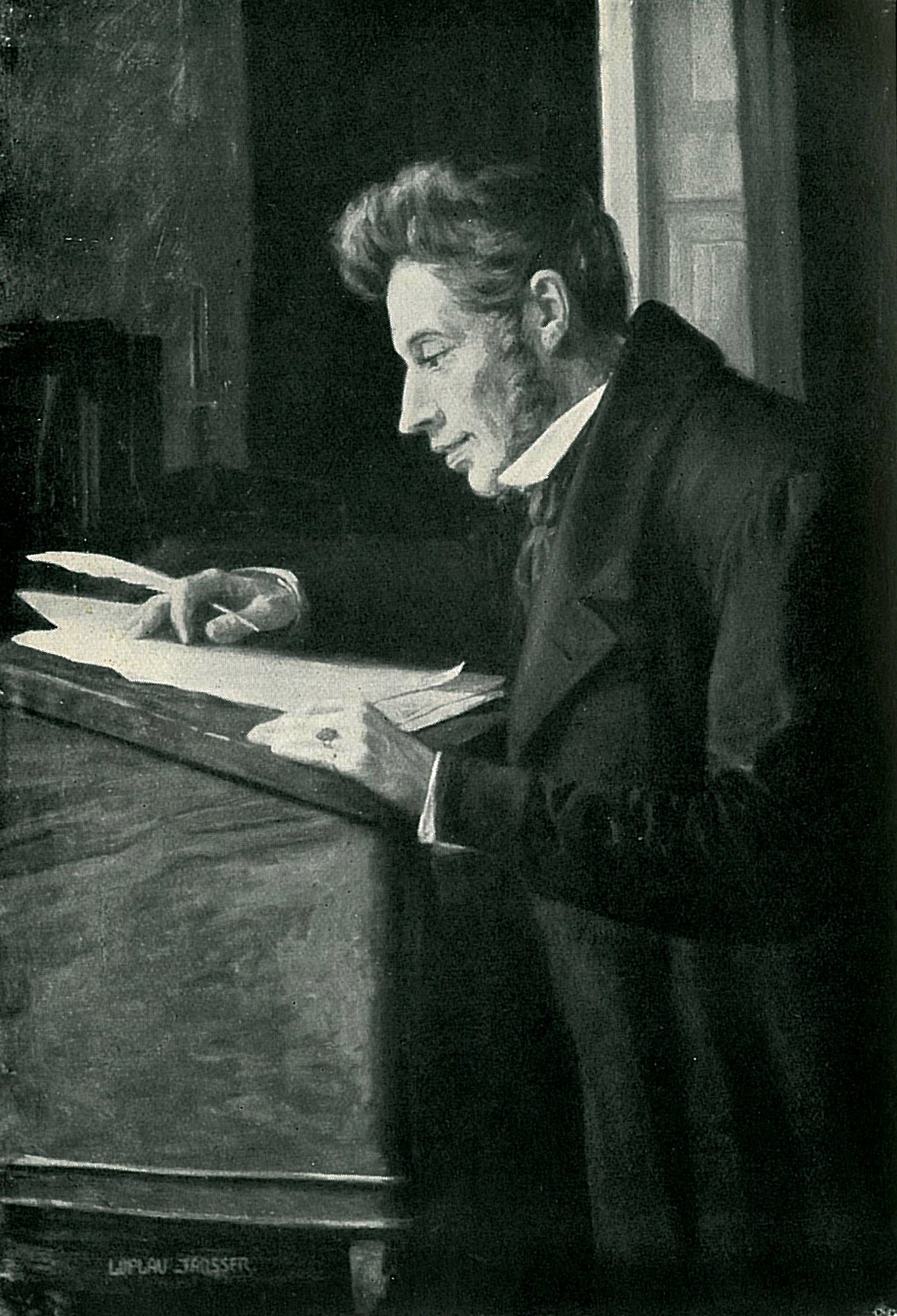
“He empties the deep sadness of existence in infinite resignation, he knows the blessedness of infinity, he has felt the pain of renouncing everything, the dearest thing he has in the world…"
To Infinity and Back Again
I. Introduction
In Fear and Trembling, Søren Kierkegaard, writing under the pseudonym of Johannes de Silentio, explores the complicated nature of faith exhibited first in the biblical narrative of Abraham and Isaac in Genesis 22. In this story, Abraham was commanded by God to sacrifice his only son Isaac, on a three-day journey to Mount Moriah where he remained silently obedient to God, only being liberated from his command by the intervention of an angel. This story is the foundation and basis of Fear and Trembling, wherein Silentio makes the distinction between Infinite resignation—a spiritual act of renouncing finite desires while preserving their eternal significance—and faith, a double-movement that embraces the absurd possibility of regaining the finite through divine intervention. Writing during the reign of German Idealism and the Hegelian philosophy that sought to surpass faith with rational synthesis, Kierkegaard defends faith as the highest human aspiration and display of passion—through the example of Abraham’s teleological suspension of the ethical. In this essay, I argue that Silentio’s introduction of Infinite resignation establishes the bedrock of faith, which in turn through a double-movement of the absurd, allows the knight of faith to transcend ethical norms and affirm authentic selfhood.
II. Infinite Resignation: The Bedrock of Faith
Johannes de Silentio introduces Infinite Resignation (IR) as the powerful spiritual movement, in which the individual renounces finite desires while preserving their passion as the eternal ideal, thereby reinforcing and authentic selfhood against existential despair. In Genesis 22, Abraham, who loves his son more than anything else in the world, is commanded by God to sacrifice Isaac on Mount Moriah. For Abraham, this is not merely a test of blind obedience but a deeply nuanced paradox, necessitating the relinquishment of the finite for the sake of the infinite. Silentio describes Abraham’s movement: “He empties the deep sadness of existence in infinite resignation, he knows the blessedness of infinity, he has felt the pain of renouncing everything, the dearest thing he has in the world…” In infinite resignation, Abraham renounces his deepest finite attachment—his son—as a display of trust in the eternal meaning of his actions. He does not abandon hope in this life but demonstrates resolve and trust in a divine reality beyond rationality. His movement is austere, lucid, and courageous, not irrational or possessed.
The preconditions for IR are threefold: an authentic all-consuming attachment to the finite object; recognition of its unattainability in the finite world; and the courage to renounce it without falling into despair. Silentio introduces the aptly named the Knight of infinite resignation, who loves a princess with such intensity that she defines his existence, yet accepts her unattainability due to worldly barriers. By letting go of the princess while preserving his love as an eternal ideal, the knight achieves an eternal consciousness, anchoring selfhood in the infinite realm where all is possible through God. These preconditions ensure the movement’s authenticity, as a lesser attachment or lack of courage would not require such a profound spiritual act.
Silentio utilizes the term “infinite” to signify the movement’s transcendence of the finite realm. In a world defined by cause and effect, venturing instead into the ambiguous but idealistic, spiritual realm of divine possibility rattles the struggle. Thus, by redirecting passion from a temporal object and then to an eternal ideal, IR defends against existential despair—the threat to selfhood when a life-defining desire is lost. Abraham’s willingness to sacrifice Isaac exemplifies this, as he preserves his love and duty to God eternally, despite the temporal loss to what he loves.
Although Abraham did receive Isaac back, the essence of IR lies in its transformation of the self through this sort of act of communion with the infinite. From communion and the struggle to uphold its commitment, marks the beginning of a greater spiritual awakening, preparing the individual for the paradoxical leap of faith, which builds upon IR’s foundation.
The “Youth” as the Knight of Infinite Resignation
To help bring this ideal to greater conception, Johannes uses the analogy of the “youth” as a Knight of Infinite Resignation. Hailing the sort of medieval heroic figure, he transfigures that archetype into someone who is willing to fall in love with a princess and dedicate his life nobly to his love for her—despite the impossibility of turning “ideality into reality.” Despite his inability to marry her due to social or worldly barriers, he is willing to sacrifice his entire existence for her. Johannes makes a keynote of preconditions here, stating that it is not a foolhardy intoxication but rather a level-headed love embodying the movement’s purity toward infinity. The knight must first genuinely love the princess, fully recognize that he cannot have her in the finite world, and still consciously renounce that love while preserving it eternally within himself.
Essentially, his eternal love becomes the most accurate expression of his genuine self, fostering an eternal consciousness rather than becoming a new person—due to the inviability of acquiring his desire. He cannot obtain her in the finite world, thus he must pursue the infinite, renouncing the finite, and connect his being to an eternal form that “no actuality can take from him.” It seems like a contradiction, yet it is necessary to bridge the dichotomy of existence through turning inwards. Only by embracing the loss of the finite can you then transform it into the eternal. This courageous movement to the eternal, the impossible, is uniquely “self-sufficient” and endures. Infinite resignation is also a continual process, that necessitates the knight’s continued renunciation against finite temptations. Although Abraham receives Isaac back through a double-movement (will be addressed in the next paragraph) the essence of Infinite resignation lies in the evolution of the self into an authentic communion with the infinite, which prepares the individual for the paradoxical leap of faith.
III. Faith: The Double-Movement on the Strength of the Absurd
Faith, as Johannes de Silentio defines it, is a paradoxical “double-movement” that develops from Infinite Resignation, and activates in the knight of faith so he could renounce the finite while believing, by virtue of the absurd, that it will be restored in this life. Unlike the knight of infinite resignation, who achieves eternal consciousness through renunciation, the knight of faith fullheartedly embraces the absurdity of the eternal to affirm both the infinite and the finite. Becoming a sort of synthesis character. Abraham best exemplifies this paradoxical action and character: he first resigns with Isaac, accepting the loss of his son, yet believes, against all rationality, that he will receive Isaac back in the finite world, as he ultimately does when God spares Isaac.
The “double-movement” consists of two distinct acts. The first movement is infinite resignation, where the individual surrenders their deepest finite attachment, as Abraham does by preparing to sacrifice Isaac, which would require unimaginable pain to his being. This movement requires the courage to let go of the finite without despair, redirecting passion toward the eternal, as discussed previously. The second movement is the leap of faith, where the individual believes, on the strength of the absurd, that the finite will be returned despite its impossibility. For Abraham, this means trusting that God will fulfill His promise of descendants through Isaac, his exhibition of faith becomes his trial. Silentio describes this as a “marvelous” act, where the knight of faith makes a movement to get everything back again. It is a bold action, the most difficult one in the world, but that is exactly why God chose this as Abraham’s test.
The absurd becomes the principle challenge to overcome in this logical paradox, that the impossible—such as Isaac’s return after sacrifice—becomes possible only through God’s intervention. By faith Abraham received Isaac. The absurd defies rational and ethical norms, which first argues that one should not sacrifice their kin (duty and ethical overcoming will be discussed later) or that such a sacrificed individual can ever return from death. Acting on the strength of the absurd means heading forth boldly within this paradox, forcing oneself to have faith in God’s power beyond our human rationality. This strength empowers the knight of faith to transcend the despair and solitude of infinite resignation, offering hope where reason sees none.
For the knight of faith, the double-movement accomplishes a powerful synthesis: the opportunity to live with “joy by virtue of the absurd” in the finite world while maintaining a relationship to the infinite. Unlike the knight of infinite resignation, who is detached and otherworldly in his abstract yearnings, the knight of faith engages fully in temporal life. Abraham’s faith allows him to return to Sarah and Isaac with great joy and relief, instead of as a tragic hero bound by ethical duties to society or an unjust and sadistic God. Rather, as an individual whose selfhood is affirmed through his absolute trust in God and His goodness. This paradox, which Silentio admits again of trouble understanding, underscores faith as the highest human passion, a continual act that renews the self’s eternal presence in the face of life’s temporal uncertainties.
IV. The Teleological Suspension of the Ethical: Abraham and Isaac
Structuring faith as a sort of act that overcomes the ethical raises a very dangerous by inspiring realization. Johannes de Silentio singles in on the “teleological suspension of the ethical” as Abraham seemingly overcomes universal ethical norms, through his willingness to sacrifice Isaac. Abraham is forced paradoxically to confront the ethical imperative to protect his child, with his obedience to God’s command. Thus, Silentio argues that Abraham’s obedience is a display of suspension of the ethical for a higher telos—his absolute commitment to God. This act is not an amoral rejection of ethics but rather a form of transcendence, where faith in the absurd—that God will restore Isaac beyond human understanding—justifies Abraham’s silence and action.
God, as the absolute authority or all matters, demands this individual duty from Abraham, rendering faith incoherent within the ethical-universal—made up of communal ethical norms. Abraham’s trust in God’s promise of descendants through Isaac, despite the command, underscores faith as a singular, authentic act that affirms selfhood beyond rational or ethical constraints.
V. Anti-Climacus’ Self and Its Relation to Faith
In The Sickness unto Death Anti-Climacus’ conception of the self outlines a dimension and point of contention between the ethical-universal and faith—necessitating a critical reevaluation of ethics’ role in human existence. Through understanding the finite and infinite dimensions of our lives, we can try to bridge a synthesis between them. To refresh, the ethical-universal embodies communal norms and universal duties that constitute moral substance in our lives, such as a father’s obligation to protect his son. Yet, the entire foundation of faith is driven by Abraham’s willingness to sacrifice Isaac on Mount Moriah, who is driven instead by his absolute duty to God. Thus, by transcending universal norms, he is placing his relation to the divine above that of the worldly.
Anti-Climacus posits that “The self is a conscious synthesis of infinitude and finitude” whose task is to become oneself, which is only possible through a self in relation to God. Only then, can one overcome the “sickness unto death,” known as despair.
Anti-Climacus makes an interesting argument for the necessity of relating our temporal relationship with ourselves, with a relationship with God, necessitating a balancing of both our finite duties and infinite commitments. Without the balancing of both sides, we risk falling into despair—as overemphasis of the ethical-universal leads to conformity. Additionally, despair can arise when infinite resignation completely renounces the finite, leading to a spiritual isolation such is the case with the Knight of IR. Additionally, this infinitized character tends to drift away from himself if he pursues such fantastic abstractions eternally. For this whole process to make sense, he must pursue the infinite but circle back to the finite self. On the other end, a finitude’s despair is to lack infinitude. Without infinitude, we despair, for the world is deeply limited. Additionally, to lack the sort of spiritual dynamism in our hearts, we became emasculated, losing a part of ourselves. Without the divine, a person loses themselves in the worldly, and forget their unique particularity, instead being subsumed to the externalities of society.
VI. Conclusion
Johannes de Silentio’s Fear and Trembling and Anti-Climacus’ The Sickness Unto Death explore the complex interplay between infinite resignation, faith, and authentic selfhood beginning with Abraham’s sacrifice of Isaac in Genesis 22. Infinite Resignation, is the first step, as Abraham simultaneously renounces finite desires while performing a double movement with the infinite, in order to overcome despair. From here, faith can emerge, strengthened by a leap into the absurd, as Abraham balances his finite duties with an absolute faith in God, achieving. Through the teleological suspension of the ethical, he additionally pinpoints faith’s power to transcend the universal-ethical, with an aim towards actuating the particular individual authentically. Anti-Climacus further explores the synthesis and balance between the finite and the infinite. In this, Kierkegaard offers a vision of selfhood as a bold gamble with the absurd, with paradoxes, and individual challenge. Only individually can we attain an authentic relationship with God, we will not be granted salvation through socio-ethical or religious conformity. We must dance alone between the infinite and the finite, between resignation and return, between the universal and the particular. Overall, through Abraham’s paradox, Kierkegaard is able to establish faith as the highest passion and an exemplar display of authentic selfhood and our individuality requires subsuming to the ideal and eternal unto absurdity.
Works Cited
Kierkegaard, Søren. Fear and Trembling. Translated by Sylvia Walsh. Cambridge: Cambridge University Press, 2006.
Kierkegaard, Søren. The Sickness Unto Death. Translated by Alastair Hannay. London: Penguin, 1985.